

Conclusion : Sgt Tom Moore's wartime journal
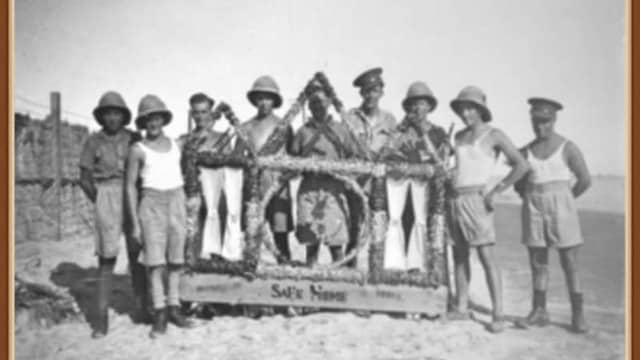

Tom Moore Junor writes: The following is a transcript of a letter I found in my father’s belongings from an Englishman by the name of Ronald T. Marriot who served with the Ninth Regt and remembered his comrades with strange accents of ‘40 years ago’.
Tom Moore Junor writes:
The following is a transcript of a letter I found in my father’s belongings from an Englishman by the name of Ronald T. Marriot who served with the Ninth Regt and remembered his comrades with strange accents of ‘40 years ago’.
This letter must have been written during the 1980s, how my father came by it I do not know.
I quote as follows:-
The heat beat mercilessly down on our pale skins, sweating and swearing in the fierce glare of burning sun on burning sand, we hauled our kitbags, webbing equipment and other impedimenta across the dry dusty compound and “got fell in” in three tired drooping dejected ranks.
We found ourselves in this God-forsaken transit camp near Cairo - a sort of mincing machine which chopped us up into small groups and dispatched us with commendable efficiency to various units throughout the Middle East.
Mine was one of a dozen or so names barked through an aperture below a huge moustache worn by a Regimental Sergeant- Major I was never to see again, but whose words I remember as though they were tattooed on my chest.
“You Lot,” he snarled, “Are posted to the Ninth Londonderry Regiment Ack, Ack.
“Know much about the Irish? Dosen’t matter a damn, you’ll join them to-morrow in Alex.”
It was October, 1940, and the Ninth, we discovered, manned the heavy artillery around the harbour at Alexandria, with Batteries at “Agami-Point” “Wardian” and Ras-El-Tin.
They were used to the heat, the flies and the nightly visits of heavy bombers and Arabian bed-bugs. Seasoned veterans, even at this early stage of the war.
We arrived amongst them white– kneed and pith-helmeted, looking and feeling rather ridiculous and very lost and lonely, like new kids at a new school in a strange place.
But not for long….
These were men with a welcome as broad as their accents.
Men from Ballymena, Coleraine, Larne, Portrush, Cookstown and Enniskillen, and men from across the border, they used strange words, like ‘fornest’ and ‘foreby’ they were warm hearted and implusie and they accepted us as colleagues without any questions.
INNOCENTS
There are certain things which pale-faced innocents in Egypt must know.
Like how to deal firmly and effectively with dirty postcard sellers, unscrupulous dhobi-wallahs and helpful natives whose young sisters are just “waiting around the corner Johnny”.
Or how to board a tram which doesn’t appear to offer as much as a toe-hold. How to make a few Akkers (Egyptian coinage) spin out until next pay parade and where the best and the worst bars in town are - and all particular health risks of the infamous Sister Street houses!
All this they taught us and since in their infinite wisdom, the War Lords had given us only a few sketchy training sessions as field gunners, none of us having ever seen a 3.7 HAA Gun, they also had to teach us anti-aircraft gunnery.
But most of all they taught us about the Irish.
In the sharing of common danger, there is forged between men a lasting bond of affinity, a communion of feeling, quite impossible to define.
In the claustrophobic confines of sand-bagged gun revetments, in stygian blackness, blasting shells at unseen enemy aircraft, there developed amongst the fear and exhilaration, the flashes and the thunder, a curious unity, totally divorced from the essential mechanics of military teamwork.
There were no Ulstermen, Englishmen, or Republicans, no Catholics, no Protestants and no Conformists, only a nameless unity of all of these.
As the War progressed we discadred our solar topees and acquired a tougher darker skin. We also acquired gradually and naturally our first rudimentary knowledge of “Irish History”
We became aware of the complex maze of religious and racial differences of the conflict of political loyalties and of old grievances, old traditions and old antagonisms.
So the campaign in the Middle East ran its course.
The Ninth Regiment was made fully mobile, pulled up its roots in Alexandria and lurched into the Western Desert.
The men of my particular battery sang their way through Mersa Matruh, Sidi-Barrani and Derna with innumerable verses of songs handed down from father to son through many decades of Irish History accompanied by Bombardier Hugh Wilson on an old accordion which we all helped to carry over hundreds of miles of desert sand.
After Wavell we served under Ritchie, Auchinleck and finally Alexander and Montgomery.
We got to know the desert well from Alamein to Bengahazi and most of the places in between and all the time the Derries sang their songs and held their parades.
Improvised banners and regalia were made from hessian, drums from empty oil containers!
Seen only by the silent stars, they marched and drummed their deep rooted loyalties into the night air and the handful of Englishmen became more and more educated in Irish History from the Stuarts and the Tudors to Cromwell and James the second and William of Orange and the Battle of the Boyne.
We learned about the 1800 Act of Union, the repeal of the Corn Laws the Lands Act and the Easter Rebellion - the whole story in fact, from the 12th Century up to the renaming of the Free State in Eire and told to us simply and naturally without rancour or bias, without anger or passion.
Swept along by the tide of the 8th Army success we reached Tripoli eventually, tired and scarred and rather proud perhaps and feeling that we had done a good job without fuss or bother.
At that stage I had to say my farewells having been posted to another unit. I retraced my steps back to Gairo, nostalgic for a sound of a battered accordion, carrying with me vague traceries of the accents and memories spanning three aand a half years of Anglo-Irish relationships.
In the forty years which have passed since then, those memorable days, I have not been in touch with any of those Englishmen who shared with me this wonderful experience but it is almost certain that we are asking the same questions.
To know a man you must live with him and having lived with the Irish under such trying and testing circumstances as near to a concordant relationship as is possible in this world we felt we knew them well.
It is doubly sad for us therefore that events in Ulster to-day pose the inevitable question how well do we really know them?
We find it rather hard to equate the open hostility towards the troops with the hand of friendship extended to us in 1940 and the rioting,the burning and the violence seem to be completely out of character with the image we cherish.
How much more difficult it is therefore for the comparatively ill-informed to see the position clearly.
In England every saloon bar politician is moved to indignant protest over the treatment to which some of the forces have been subjected, but he is always sure as to why it happened.
He knows exactly what is happening but doesn’t know why.
The root causes reaching so far back in history are unknown to him.
He sees the Irish as undisciplined irresponsible children of violence and advocates complete withdrawal of troops.
His motto let them get on with the business of self destruction, since that seems to be what they want.
A recent public opinion poll conducted by one of our larger daily newspapers showed that a high percentage of opinion favoured a withdrawal of troops but agree that if this happened the situation would rapidly deteriorate.
I have no doubt whatever that all the Englishmen who served with the Derry’s will be trying to foster a better understanding of the Ulster situation.
We are not politicians and do not believe in magic. We know that the solution to Ireland’s problems will not be found overnight.
PROGRESS
But surely war has taught us all, on both sides of the water, that violence solves nothing and I believe that there must be an end to it before any progress is made and the Irishmen that I once knew would agree.
I think of the men with whom I shared so much. Big Hughie Wilson, wee Freddie Torbett, Charlie McCluggage, Bobby Loughridge and hundreds more.
I should like them all to know that I still hear the voice of the R.S.M. in Cairo, know much about the Irish? Doesn’t matter a dam.
To some of us it matters very much.