

Part 1: Sgt. Tom Moore's journal gives a glimpse of wartime life for Ballymena's gunners
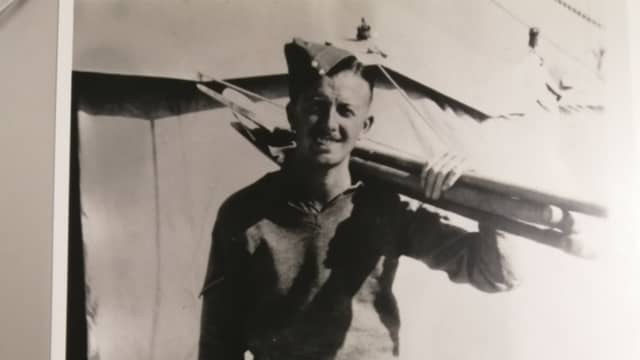

My late father commenced writing this journal in an old exercise book from the old Ballymena Tech during 1946, shortly after the war ended. It was his intention to finalise the work with the possibility of seeing it published in the local Ballymena Observer.
My late father commenced writing this journal in an old exercise book from the old Ballymena Tech during 1946, shortly after the war ended.
It was his intention to finalise the work with the possibility of seeing it published in the local Ballymena Observer.
However, as time passed he found more and more old soldiers were writing about their experiences during the war years and he decided to put the book away to be competed at an other time.
As the years went by he continued to add to his journal and eventually stopped at Naples in Italy but his stories to me continued through his experiences in Rome and eventually home.
Through his stories to me and his hand written journal I have tried to piece together the blanks that are missing and of the men of the 2/6 Battery. The old school book in which he wrote was resurrected by me shortly after my father’s death and I’m delighted to see his recollections about the role played by so many local men being published in the Ballymena Guardian.
I joined Ballymena Services Club as a Member in 1980 but had often accompanied my father as a quest in many occasions where I met and got to know old soldiers and comrades of my father.
It was not long after this that I joined the Ballymena Branch of The Royal Artillery Association and once again met up with some of the 2/6 Battery men which I have listed below together with a 2/5 Battery man who had “ immigrated’’ from Londonderry to Ballymena [ Mr Jim Soutar ] and others.
Through various functions held by the Artillery Association and the Services Club those old soldiers told me of good memories and sad memories of their comradeship during their travels together far from home during 1939-1945 with the “Ninth”. My father never mentioned any names of his mates or other army personnel in his journal that he had met or socialised with on his travels and I got the impression from his army back ground “ No Names No Pack Drill’’. However he would often speak to me of his mate’s names and places they had been to through his reminiscences and stories, some of which I have brought to mind within this journal.
Mates like – Arthur Mc Dowell, Alfie McClean, Willie McClean, Elmer Fallis, Freddie Eaton, George Kernohan, Ernie McCready, Robert Blair, John Marcus, Leslie Mooney, Tom Nixon, Tom Adair, Jock Bell, Hughie Hill, Alex Logan, Arthur McNinch, Johnston McNally ,Hugh Wilson and Major John McConnell to name but a few.
And there were place-names from the pages of an atlas, far off locations with strange sounding names which became very familiar to me as the gunners spoke of their experiences over a few drinks when in the Services Club. The men of 2/6 Battery Ballymena and outlying districts that I had the honour and privilege to have met are no longer with us and have gone like my father to join the Heavenly Artillery and I hope in some part that I have kept their memory alive through my late fathers journal.
Finally this journal is not to be taken as an historical account of the “ Ninth’’ or the Batteries associated with the Regt but should be read as one Gunners personal experience of the time he spent with his comrades.
Tom Moore (Junior)
By Sgt Thomas Moore
I was a terrier (TA) Territorial Army - known in Northern Ireland as the Supplementary Reserve - in a provincial town in Northern Ireland named Ballymena.
I was a gunner in 2/6 Battery stationed at Lowfield Camp within the Demesne Estate. My Battery was part of the 9th Londonderry Heavy Anti-Aircraft Regiment Royal Artillery (SR). Our Battery Commander at Ballymena was Major Anthony O’ Brien Trail, Regular Army.
2/6 Battery consisted of men from Ballymena, Larne, Ballymoney, Bushmills and Castledawson. The camp was guarded by members of the Ulster Special Constabulary as we had no rifles.
It wasn’t until Sept, 1939 that we were supplied with a few and the services of the U.S.C. were no longer required. The battery Captain was Sam Haughton from Cullybackey and he was later to become 2/6 Battery‘.’s Major.
I remember well my joining up 22nd May, 1939. The P. M. at that time, the late Neville Chamberlin was endeavouring to prevent war. But of course as everyone knows, it wasn’t a success. Then that dreadful day came on 3rd September, 1939 and we were at war with Nazi Germany.
All of us, that is members of the T.A. , were called upon to proceed to our Battery Headquarters to hear what was in store for us.
Soon afterwards I was detailed for the advanced party, which consisted of about fifty men. The day of our departure was a Sunday and we boarded the train at Ballymena Station with destination for the present unknown. After the train journey we moved to a little seaside resort in Co. Down. There we spent two weeks doing very little, except for guard duties armed with a pick shaft. Afterwards we made ready to welcome our main party, who at the time were billeted at another camp some 12 miles away, we spent a further two weeks before embarking for England - again, destination unknown.
ENGLAND
In England we were billeted at a proper Army Barracks. I might say we had a good time during the train journey to the Barracks we were given refreshments at some of the main stations by the Welfare People. It was quite an experience for most of us, visiting the pubs of the little villages for miles around, I for one, having my first drink of English beer.
Things went pretty smoothly except for one incident. This happened in the canteen attached to our barracks, when one of our chaps happened to get on the wrong side of the waitresses, who called him an IRA man because we were Irish.
Some strangers belonging to another unit agreeing with her started a regular rough house and for a time everything was topsy, turvy.
Things were straightened out and everything returned to normal. But for the remainder of our stay, the canteen piano could be heard playing hardly anything else but Irish Airs.
A short two weeks another train journey and we arrived at the port of Southampton.
After receiving some tea etc we were aboard ship. Mail bags were opened and we received our letters. Soon afterwards our ship pulled out from the quay side into Southampton water.
As before destination unknown, but we had a sneaking suspicion it was the East, as we heard that our officers had received equipment drill consisting of mosquito nets etc. The ship stopped in a short time and everyone was anxious as to what next. Then we heard that we were waiting on our escort. A destroyer duly arrived and the convoy started off.
According to one member of the crew it was the roughest night he had experienced in fifteen years. The ship not helping any as she was top heavy, one of the old cross channel ferries.
I thought that night was never going to end. I was so sick I didn’t care what happened.
Our quarters consisted of a little cabin with wash hand basin, four to a cabin with on two bunks, the unlucky two having to bed down on the floor.
The wash hand basin constantly in use as you can imagine, I felt I was going to bring up my insides. Later the cargo shifted a little causing the crockery in the crews galley to be smashed, which left most of use to believe we had been torpedoed for all this I didn’t care, being so sea sick.
Further along the passage way another incident occurred. Some of our chaps in another cabin hadn’t got the port holes properly closed and due to the heavy seas they had burst wide open which caused the water to come rushing in and in the excitement couldn’t get the cabin door open causing the water to get higher and higher. Eventually they managed it, the water rushing along the passageway but not before getting drenched to the skin. I heard afterwards they thought they were goners.
FRANCE
Morning came and we docked at the port of Cherbourg in France. Lined up along the quayside we looked a sorry sight after the rough crossing, the fellows in the cabin which had been filled with water standing with teeth chattering in the cold. Then came breakfast and believe it or not I had a wonderful appetite a mug of black tea in one hand and a tin of herring in the other, with half a loaf of bread between my knees, waiting on someone to open the tin of herring.
Continued from page 14. Afterwards we were marched off to the station, where we were told to have a few hours leave before catching a train.
The station was very large at that time consisting of quite a few shops, where we could buy some cigs, newspapers etc. I learned afterwards that the station suffered a lot through bombing. Any English money we had was quickly changed into francs and we, or rather I, as I was on my own set off for the town, which was quite a bit away from the station.
As I arrived in the town I could see members of my own unit walking around sight seeing. Quaint little shops selling all sorts of wares. Stopping at one of the little shop windows I could see they sold postcards, I stepped inside and bought a few. I also purchased some stamps and right away sent home to my people to let them know that I had landed in France.
I continued on my way and as I was passing the doorway of a little pub I could hear some of my pals inside. In I went and joined the merry party, being served with lovely French beer.
After a couple of beers I thought I would try some brandy but that was not to be as the landlady pointed to a poster in French saying ‘no’. Not being able to read French or even write it I was at a loss to know what was wrong then all of a sudden I caught on to it, it was a police notice saying they were not allowed to sell English troops liquors, beers only. Never the less quite a few of our chaps sampled the brandy as they got some French soldiers sitting around to order some for them.
By this time I was feeling hungry and in a little room off the bar I spied a table set for a meal. The temptation was too great so a couple of my pals and I went in to have a look around, the landlady being too busy to notice, serving some customers.
In a short time we were wading into the food which consisted of cheese, tomatoes, lettuce, radishes etc. It was what was known as a clean sweep nothing being left.
We were just finished when the landlady walked in. Although we were willing to pay she would not accept anything, but she gave us a good telling off in French gesticulating with her hands and talking thirteen to the dozen. The time wore on when we had to report back to the station.
The roll was called and some were found to be missing, the French brandy had done its work! Things were straightened out and we boarded the train at midnight with our destination more or less a secret. Again we were a bit pinched for room, eight to a carriage plus our kitbags and knapsacks etc, which in normal times held only six persons.
The train started and we were on our way, in less than an hour tea was being served, this consisted of bread and more tinned herring. Some of the lads were detailed to carry the tea along the swaying corridors, the tea being ladled out by means of a pint mug.
More of the tea went on the floor than we received in our mess tins owing to the carriages being rocked about.
As the night wore on we tried to make ourselves more comfortable. All our own kit was piled on the floor between the seats of our carriage which made a rough sort of a bed that we could lie on but two of our chaps found the baggage racks a bit more comfortable and bedded down there for the remainder of the night but for all this the remaining lads could not get enough space, we were as close as peas in a pod.
After a time I got fed up and wandered along the corridor towards the top of the train, always drawing near to the officer’s compartments, I had a pal doing batman for one of the officers, so I thought if I could see him I might be able to get some extra rations.
At last I found him almost asleep and in a short time I was making my way back with a pile of foodstuffs in my arms - tins of jam, plums, herrings, biscuits, bully beef and about a dozen packets of Smiths Crisps.
When I arrived back to my compartment we had a real good tuck in. This was only one of many trips I made during the train journey.
We had plenty of army rations. In fact we fed many of the French people we met along the way. A thing that struck me greatly was the French blackout which really was a blue out plenty of lighting of a dark blue colour.
Back in Northern Ireland our blackout was so perfect one could not find their way at times.
As we passed railway crossings we saw cars with their headlights blazing full on.
During the night we stopped for sometime on the outskirts of a big town where we could see the blaze of light from a blast furnace, I thought to myself if the German bombers were to come over now.
Morning came and we stopped once again this time in a train station, looking out the window I could see an old fellow coming along the platform with a little truck full of newspapers, sandwiches, also bottles of wine, I called him over and got a bottle after a lot of trouble because of the language problem.
After opening the bottle I handed to one of my pals, putting it to his head he took a good swig, but he was much quicker taking it away, bloody vinegar he exclaimed.
I tried it myself and found it to be quite sour. I laughed at this as I had heard previously that some French wine had a sour taste. For all of this we finished off the bottle.
Off again passing through towns and villages. Our next stop came some hours later, we got out and had a good run round to stretch our legs.
Here I bought a little flower in aid of the French Red Cross sold to me by a lovely little French girl. Some of the other lads were getting souvenirs of French monies in exchange for English. The war had not touched this part of France as yet.
Our journey continuing we arrived at the port of Marseille. We got off the train and formed up on the platform and marched aboard our troopship.
This was a swell ship, not like the one we had crossed the channel in. She belonged to the P&O Line converted into a troopship (HM Troopship Ettrick)destination unknown. In a few hours we set sail under escort from the Royal Navy.
The first day I was due for an inoculation which I had missed previously and though the sea was pretty calm I was very sick due to having received the needle.
One of my pals was receiving double dinners in sick bay for three days because of this.
The time aboard ship was spent at leisure except for occasional guard duty.
There were plenty of open air concerts on the top deck. Those were lovely moonlight nights in the Mediterranean Sea.
One of our four chaps had a horror of submarines and every piece of flotsam and jetsam was the periscope of a submarine to him.
Every twelve or fourteen men were allocated a mess table, the rations all drawn by a man detailed to get these from the cook’s galley. When night came hammocks were drawn and slung above the mess tables.
MALTA
The ship arrived at Malta as first port of call.Just before this our only ‘sub’ was sighted, but it was flying the good old White Ensign of the Royal Navy.
We were not allowed ashore at Malta where anchored in the Grand Harbour for a few hours.
This little island was to take on the might of the German and Italian Air Force and was constantly bombed due to its strategic position in the Mediterranean Sea.
Our ship in a short time was to be surrounded by little boats selling fruit and silk etc. After a few hours anchored in the Grand Harbour we set sail once more for Alexandria approximately 1000 miles away and base for the Mediterranean Fleet. And so we landed in Egypt.
EGYPT
Everything about this country was a new experience for us, its customs and its people.
Alexandria has a very big harbour and as we steamed in we could see all sorts of craft in the harbour, Destroyers, Corvettes, Cruisers, Battleships and a couple of Aircraft Carriers.
Everything was hustle and bustle as we disembarked from our Troopship. Stores being unloaded including our kit, then we had a bit of a rest and whilst all sorts of native peddlers gathered around us, selling, begging anything to get money.
The native conjurers referred to more often as Gali, Gali men, who produced live chicks from out of the blue, out of his ears and mouth etc. a motley collection of shoe-shine boys, sellers of fruit, postcards, sweetmeats and many others. These consisted of Arabs, Bedouin, Sudanese, Greeks and many other nationalities.
Then the train arrived to transport us to our own camp some miles outside of Alex.
Our troubles were just beginning. The other units who shared our camp, didn’t expect us so we were short of food. One of our officers came to the rescue, by standing us all to a good meal in the camp N.A.F.F.I., this took the form of eggs, chips tea bread and butter. Fortunately some of us still had got English money and this was spent on beer of which the N.A.F.F.I. had a good supply.
Then back to our lines which were all tents in fact all of the camp was the same, there to make our beds and get down for the night, the mattress was a thin ground sheet laid on the sand, over this a blanket and then a couple of blankets on top.
The sand rocked to and fro all that night as I thought I was still aboard ship, I had not got my land legs.
Up bright and early next morning, parties detailed for various duties, drawing small trestles and bed boards from the stores, mattresses and Khaki Drill, sun helmets, all the things that a soldier needs in the East.
After supper at night there was the Garrison Cinema with projector break owns as many times in six in an hour!
Aat other times we had English Concert parties. These were composed of English civilians and Officers wives etc whose endeavour it was to make everyone feel at home.
Shortly afterwards we were issued with passes to visit Alexandria as this was more or less a peace time army of ours made up of Garrisons in Alex, Cairo and other towns throughout Egypt, with a small force in Egypt and Libya frontiers.
Italy had not as yet declared war at this time, it being before Xmas 1939.
We were a Heavy Anti-Aircraft Regiment but so far without guns, we had practically no training before leaving home and I wouldn’t have been surprised if the lads didn’t know which end of the gun the shell came out of.
During the day we had plenty of squad drill and guard mounting etc. We were more like an infantry regiment except for the lectures on Gunnery.
I will never forget my first night in Alexandria, first of all in entering the City I was played for a sucker, a little native boy selling newspapers, I handed him a 10 piaster coin, which is approx two shilling, after searching through his dirty robe for change he shook his head, looking at me he said in broken English, no change Johnny and handed me back the coin.
He was well out of sight when I discovered it was a dud made out of lead, there was a large amount of this money going around although we did not know it at the time.
After this we used to be more careful holding unto the boy’s until we found out that the money was okay.
One cannot visit Alexandria without visiting the Fleet Club, run by the Naval people and very good to. There one can have plenty to eat and a great variety in the cooking. All sorts of drinks with very nice iced beers, barber shop and book shop etc.
There was also other Soldiers Clubs such as the British Services Club which is the oldest, The Forces Club, Britannia Club, Petty Officers Club and many others.
There is also some very nice Hotels one of the most popular being the Hotel Cecil in the Corniche at Ramleh, this is for Officers only.
There were also Cabarets in all Night Clubs, it was a very modern City, at least part of it. The native quarter was full of slums, small dirty vile smelling streets. Part of these were spread behind the sea front, known as Rue Corniche (Coast Road).
Fronting the sea were many imposing buildings, hotels, cafes, dance halls etc.
It was indeed a lovely sight, a miniature French Riviera, the road extending for about 13 miles. King Farouk of Egypt had two Palaces at the end of it, Ras-El-Tin and Mustapha near the Aboukir area where Admiral Nelson won a battle, defeating Napoleon, better known as The Battle of The Nile.
I was to spend about two years in Alexandria except for a few months in Port Said.
Continued next week