

Tom Moore's WW2 memories part 4 - Hunger, disease, bombs and a volcano erupts!
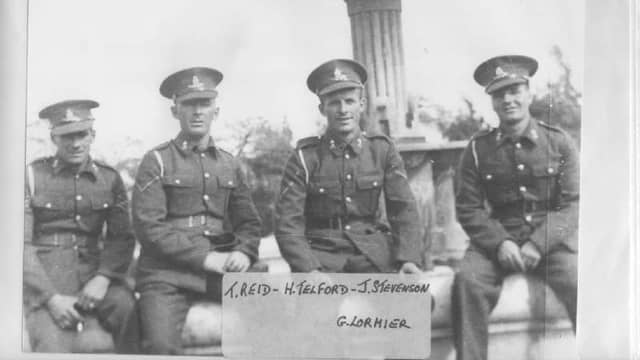

Naples fell to U.S. General Mark Clarke’s Fifth Army on the 1st October, 1943. Naples was the first great City of German Europe to fall into Allied hands.
Naples fell to U.S. General Mark Clarke’s Fifth Army on the 1st October, 1943.
Naples was the first great City of German Europe to fall into Allied hands.
Here was the start of other great Cities to fall such as Paris, Brussels, Berlin and others.
At last we could find out what life had been like under Nazi rule.
As we drove over the Sorento peninsula we caught sight of the City for the first time.
There were other little towns and villages we passed through such as Pompeii and Castellamare.
The black peak of the volcano Vesuvius was on the right and the Isle of Capri was on the left sitting out in the bay.
There was plenty of oranges and sunshine around these parts. As we drove through Pompeii and Castellammare the crowd was thick on the roads.
This was a mixture of guns, tanks and all sorts of war equipment as well as civilians.
As we got closer to Naples it became grim.
When we stopped we were surrounded by pleading men and women. In every direction there were hungry dirty faces.
I thought the people might be hostile but there were some who actually showed affection.
Others thrust their children forward all crying for bread, biscuits and cigarettes. They leaned out of windows screaming as the Allied troops went past.
When anyone of us threw a cigarettes or sweets there was a mad rush and they would beat one another for them.
Each day the pimps and black marketeers increased along the Via Roma.
“You want nice girl? Good brandy very cheap, beautiful signorina ...” The usual lines.
We took up a defensive position around Naples Harbour as this was a major port for supplying the 5th Army.
The first heavy raid by Gerry on the harbour took place on Oct, 1943, this is where 25Bty suffered a direct hit on one their gun site killing 15 and wounding five.
Among the dead were 10 Basutos from the Orange Free State, South Africa. The remains of the dead are buried in the Military Cemetery in Naples.
Our Regiment moved out of Naples in late December, 1943 to new positions at Annunciata and Castellammare some twenty two miles away.
These locations had small ports bringing in supplies to our Armies which required to be defended against enemy aircraft. 26 Battery was stationed at Castellammare approx nineteen miles from Mount Vesuvius which eruptedon 18th March, 1944 and we were to assist in the evacuation of civilians from the mountain.
A few days before this some of my pals including myself had been on top of the mountain looking down into the crater.
One village on the mountain side was over whelmed by lava and troops with transport were standing by to evacuate everyone.
As far as I knew there were no casualties. It was indeed a wonderful sight at night, the mountain generating its own electricity, around the crater the lighting was flashing in all directions.
Our camp was some miles out of Naples, but never the less pieces of stone lava etc kept falling all around us.
We had to wear our tin hats and great coats. There was also plenty of dust and smoke.
The sun was completely blocked out for a week or more and day was turned into darkness. A big majority of the Italians thought the end of the world had come. Gradually all rumblings and the flow of lava ceased.
As the dust and sulphur fumes cleared away we could see that the crater had changed its shape.
Instead of being cone shaped it had almost become flat in appearance and smoke had ceased to come out of it. Vesuvius was dead and the native population looked upon this as a bad sign.
In Naples, Typhus had broken out and the disease began to develop into an epidemic.
The cold and hungry people died very quickly.
The medical staff of the Army rushed to Naples and people were being sprayed with anti Typhus powder and given injections.
The water supply was bad and hundreds of people were living among the ruins.
Then the Typhus started to come under control and not one British or American soldier was infected, although they had moved among the population. The Typhus injections which they had received had worked wonders.
Then a serious disease came to the Army.
This was the sexually transmitted Gonorrhoea. Even the drugs that our medics had seemed to be no good. Hundreds of cases were reported each week, there were more casualties from this than from enemy action.
Everywhere there were notices warning the soldier against the disease but at last it too was brought under control.
Then another terrible thing was to strike the City of Naples - deadly German time bombs.
The mines were placed in large buildings such as the Post Office and Telephone Exchange.
They had been hidden there by the Germans before leaving. The one which went off in the basement of the Post Office killed and wounded many civilians.
In the desert it wasn’t so bad, soldier against soldier but killing innocent civilians, this we did not approve of , and this bred deep hatred against the Germans.
ANZIO
Ninth Regt moved into position at Anzio on the 6th June, 1944 - in Normandy it was D-Day.
There were a number of air raids by the Luftwaffe over Anzio harbour but no damage occurred to shipping mostly due to our anti-aircraft gunnery skills.
Enemy air raids became fewer and coming up to the end of June the Regiment’s role changed once again to field artillery except for 26 Battery whose role remained as Anti Aircraft defence.
From Anzio we moved to an area near Naples and from there to Livorno not far from the Leaning Tower of Pisa.
ROME and HOME
The Eternal City was liberated by soldiers of the American 5th Army under General Mark Clarke on the 4th June, 1944, while fighting was still going on around the Anzio area.
We were in Salerno for about a month, then moved by land up to Anzio and then to Livorno as said before.
We stayed there for quite a while and then in early September 1944 we heard that we were due for home.
We had been four years and ten months overseas.
We handed in our guns in Rome and our instruments, radar and all equipment in Naples.
We lay in Naples for six to eight days then aboard the Orontes a P&O Liner and landed in Liverpool on 17th September, 1944.
Then it was home for some leave.
When leave was over we went back to England.
26 Battery was stationed at Ticknell, Weybourne the Humber, Hendon and Grimsby to have ago at the V1 and V2 Flying Bombs.
This was during October 1944 and August 1945. World War Two ended in August, 1945.
We remained in England until after V. E. Day in Europe.
I was demobbed on 27th November, 1945 and placed on reserves for six months. Fnally I was released from even that and it was back home to Ballymena.