

Public access to Dungonnell under threat as Quad bikers accused of causing 'alarming damage'
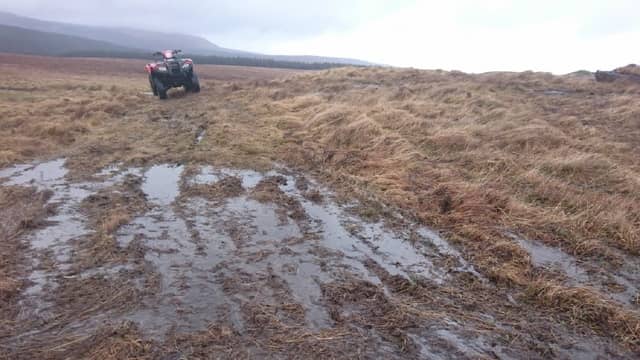

NI Water is appealing to the public to be vigilant and report anti-social behaviour, including the use of numerous quad bikes, at the Dungonnell Reservoir near Cargan.
NI Water is appealing to the public to be vigilant and report anti-social behaviour, including the use of numerous quad bikes, at the Dungonnell Reservoir near Cargan.
According to NI water, damage to the natural enivironment is becoming ‘alarming’.
And it has warned that the entire area could be clsoed off to the public if the problems do no cease.
Stewart Walsh, Area Manager explains, “NI Water would appeal to community and political representatives to support us in tackling any further quad or scrambler biking at these locations.
“The number of bikes showing up and the severity of the damage is increasing to an alarming state.
“The whole community needs to help us put a stop to this behaviour before this impacts on vital water services, which are essential for the local community.
“NI Water strictly prohibits the use of scramblers or quad bikes on our sites and would urge those involved to cease this activity immediately.
“What may seem like harmless fun is in actual fact an extremely dangerous activity and it risks damaging vital water supply resources.
“The Garron Plateau, which supplies drinking water to Dungonnell WTW has seen major investment and upgrade work over recent years to make it the wetland it is today and this activity is damaging this sensitive and protected habitat.
“NI Water depends on the common sense and goodwill of those using these areas to treat them with respect.
“It is a shame that the selfish acts of a few are impacting on the enjoyment of the many who visit these areas.
“ This activity, plus recent incidents of vandalism have been reported to the PSNI and we are actively working with them for a permanent resolution.
“Anti-social behaviour at these reservoir catchments can have serious consequences.
“Someone could get injured or key services could be disrupted, which is a needless drain on limited resources that could be better invested elsewhere.
“If such behaviour were to continue, NI Water would have to consider securing the areas and closing them off to the entire public; an action which would be regrettable to take.
“We understand people want to make the most of these scenic areas, particularly over the summer months, but we would ask everyone to respect them. Report any inappropriate behaviour or vandalism to the Police on 101 or Waterline 03457 440088.”
In 2013 NI Water in conjunction with RSPB and NIEA began the Garron Plateau Bog Restoration Project to restore the largest expanse of intact blanket bog in Northern Ireland to a favourable condition and to improve the quality and reliability of the water received at NIW’s Dungonnell treatment works which is supplied by the Garron catchment.
The project aims were to:-
Re-establish natural hydrological conditions and restore the function of the bog, thereby reducing greenhouse gases;
Conserve biodiversity by preserving bog features that support a wide range of plant and animal species;
Prevent peat erosion, thereby reducing treatment costs and carbon footprint of Dungonnell WTW; and
Improve raw water quality and reduce variation in water quality in the reservoir by improved regulation of supply through filtering and retention effects.
In liaison with RSPB and NIEA, a catchment management plan was delivered in 2013-14 under the Futurescapes Project, with the objectives of restoring the Garron Plateau blanket bog to ‘favourable’ condition by 2016.
The plan has been delivered through working with farmers to reduce grazing density levels, and the employment of a specialist contractor to carry out the first phase of drain blocking using peat, timber and stone dams to raise the water table.
This “re-wetting” of the bog has helped restore natural hydrological conditions, restore carbon sequestration (storage) and promote colonisation by Sphagnum moss, an essential component of a functioning bog.
Raw water quality coming off the bog has improved, with colour, turbidity and total organic carbon being reduced and attenuated since the restoration began.
Phase two of the project (2018-19) was completed as part of the ‘Cooperation across Borders for Biodiversity’ (CABB) INTERREG VA project in conjunction with RSPB.