

Saluting Ballymena VC hero of the Crimean War

Remembering Alexander Wright, the courageous local man who laid his life on the line for others.
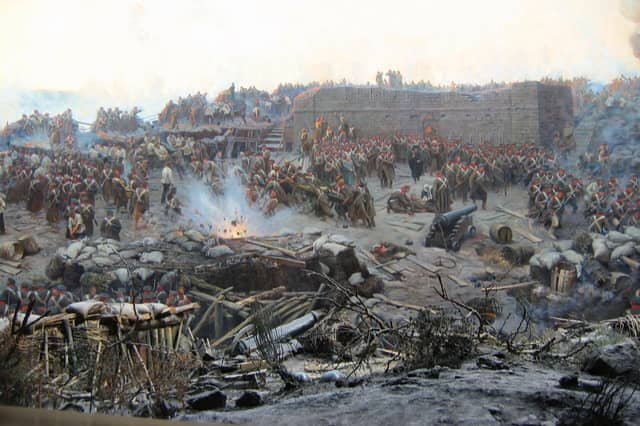
WHEN THE Victoria Cross was first issued to honour meritorious acts of valour performed by British soldiers in the Crimean War, rumour had it that the medals - devised to be the highest decoration that could be awarded to servicemen - were stamped from the same Russian cannons which reigned fiery doom from their earthworks during the ruinous Siege of Sevastopol.
It is a rumour that has come to be debunked, but the VC still stands as the British Empire’s highest recognition of bravery on the battlefield - and among the earliest first to wear it was Ballymena private who went above and beyond the call of duty in that very battle.
Born in Ballymena in 1826, Alexander Wright enlisted into the 77th (East Middlesex) Regiment of Foot in 1846.
Within eight years, he was thrust into the Crimean War, a brutal geopolitical clash pitting Britain, France, and the Ottoman Empire against Imperial Russia over influence in the crumbling Ottoman territories and control of the Black Sea.
Landing on the Crimean peninsula in September 1854 with the Light Division, Private Wright and the 77th fought at the Battle of the Alma and survived the bloodbath of Inkerman in November before settling into the gruelling Siege of Sevastopol.
Across a bitter winter, British soldiers endured inadequate shelter, frostbite, cholera, and relentless artillery bombardments in waterlogged trenches. The grim stalemate was punctuated by occasional frontal attacks against Sevastopol’s bristling fortifications, each of which took a heavy toll in manpower.
In many ways, the stagnant, industrialised slaughter endured by both sides on the Crimean peninsula served as something of a portent for what was to come in the First World War some sixty years later.
During the siege, Wright’s composure under fire set him apart.
On the night of March 22, 1855, Russian forces launched a massive sortie against British siege works under cover of darkness.
As forward trenches were overrun in fierce hand-to-hand fighting, the local private stood his ground, rallying comrades to help beat back the assault.
Four weeks later, on the night of April 19, 1855, Wright was again in the thick of desperate trench warfare during the storming and capture of Russian rifle pits before Sevastopol.
Leaping into the pits under heavy musket fire, Wright helped hold the captured ground against fierce counter-attacks, calmly gathering ammunition from fallen comrades to maintain steady fire.
His citation also says he repeatedly risked his life venturing into no-man’s-land to drag wounded comrades back to safety under shellfire.
When Queen Victoria instituted the Victoria Cross in January 1856 to honour supreme gallantry regardless of rank - previous decorations having been heavily weighted in favour of the officer class - Wright’s name was swiftly recommended.
His official citation, published in the London Gazette on February 24, 1857, reads:
"For conspicuous gallantry on the night of the 22nd March, 1855, in repulsing a sortie; on the night of the 19th April, 1855, at the capture of the Rifle Pits; and on numerous occasions during the siege, particularly in rescuing wounded men under heavy fire."
Britain’s French allies also recognised his bravery, awarding him the Médaille Militaire in May 1857 with a citation praising his ‘coolness and intrepidity, and especially in bringing in wounded men under the hottest fire’.
The end of the Crimean War in 1856 afforded the men of the 77th no rest. With the outbreak of the Indian Mutiny in 1857, the 77th Regiment was deployed to Bengal in 1858.
It was here that, having survived Russian bullets, bayonets, and frostbite unscathed, Wright died in unclarified circumstances in the oppressive heat of Calcutta on July 28, 1858, aged just 32.
Regimental histories indicate the 77th was in garrison duty on this date and uninvolved in pitched combat, so it can be surmised that the local Victoria Cross winner succumbed to one of the many diseases men deployed to the colonies were susceptible to.
Alexander Wright’s grave has long since been lost to time, along with much of the public record telling of his exploits.
He never returned to walk the streets of Ballymena, dying an anonymous death devoid of glory far from his home, and most natives of the town he hailed from have never heard the name of one of the first winners of Britain’s most premium bravery decoration.
Nonetheless, his original Victoria Cross remains on display in the Lord Ashcroft Gallery at London’s Imperial War Museum, an enduring tangible connection to the distant killing fields of Sevastopol where a local man put his life on the line for Queen and Country.