

Ballymena man’s extraordinary despatches from the front lines in WW2
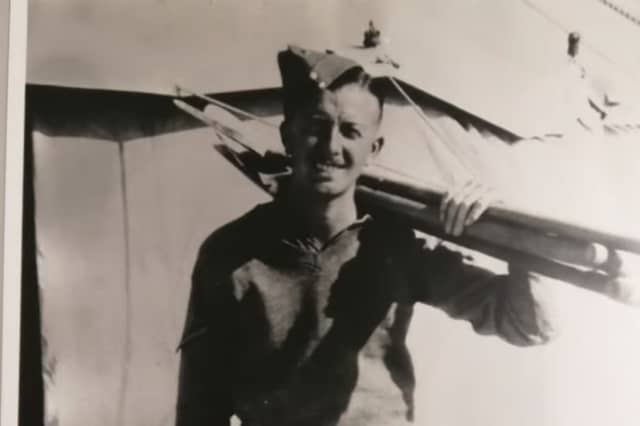

Ballymena man Tom Moore charts his role in World War 2
“I REMEMBER well my joining up 22nd May, 1939. The PM at that time, the late Neville Chamberlain, was endeavouring to prevent war. But, of course as everyone knows, it wasn’t a success.
Then that dreadful day came on 3rd September, 1939, and we were at war with Nazi Germany.”
So began the greatest, most dreadful adventure of Tom Moore’s life. Serving as a ‘terrier’ - a pre-war Territorial volunteer gunner with a heavy anti-aircraft battery of the Royal Artillery - his war would unfold against the backdrop of a global order in the throes of violent flux.
From the blazing sands of the Western Desert to the inferno at Salerno, the impoverished backstreets of a withered Naples to the slopes of an erupting Mount Vesuvius, this local everyman did something remarkable: he put all his experiences to paper.
Sergeant Moore began jotting down his experiences in an old Ballymena Tech exercise book in 1946, not long after his demobilisation.
He had originally hoped to see them published within the pages of the Ballymena Observer but, aware of the wave of testimonies from other servicemen flooding the presses, he quietly set his manuscript aside to be completed at a later date he never lived to see.
It is only through the efforts of his son, Tom Moore Jr, that we have access to his story.
Transcribing the notebook and immersing himself in the veteran community through the Ballymena Services Club and the Royal Artillery Association, Tom Jr. got to know other local servicemen like Arthur McDowell, Alfie McClean, and Freddie Eaton - unnamed by doctrinal necessity in his father’s written memoirs, but familiar from the stories he’d been told at home.
By piecing together his father’s written journal with memories shared with them, Tom ensured the legacy of 2/6 Battery was preserved.
"The men of 2/6 Battery Ballymena and outlying districts that I had the honour and privilege to have met are no longer with us and have gone like my father to join the Heavenly Artillery,” Tom Jr. wrote upon the manuscript’s eventual serialisation in the Ballymena Guardian.
“I hope in some part that I have kept their memory alive through my late father’s journal."
As the ranks of that generation filter through the mill of time, falling out to the drumbeat of the passing years, primary sources such as those penned by Sergeant Moore remain invaluable touchstones of a world-changing event that is gradually slipping out of living memory.
When Britain formally declared war, Gunner Tom Moore was stationed at Lowfield Camp within Ballymena's historic Demesne Estate.
His battery represented a true cross-section of North and Mid-Antrim, drawing men from the streets of Ballymena, Larne, Ballymoney, Bushmills, and Castledawson under the command of Captain Sam Haughton, heir to a prominent Cullybackey linen dynasty.
"The camp was guarded by members of the Ulster Special Constabulary as we had no rifles," Sergeant Moore noted - a striking snapshot of a British army caught unprepared for immediate conflict.
“It wasn’t until September 1939 that we were supplied with a few and the services of the U.S.C. were no longer required."
Indeed, before full kit arrived, Moore spent his first sentry duties armed only with a pick shaft.
The uneasy quiet did not last. Detailed to an advance party of 50 artillerymen, Moore departed by rail to an uncertain fate.
"The day of our departure was a Sunday and we boarded the train at Ballymena Station with destination for the present unknown,” he wrote.
By 1941, the Axis powers had turned their attention to North Africa and the Middle East, seeking to sever the imperial lifeline at the Suez Canal and seize the vital Middle Eastern oil fields.
And so, amid the sweltering Egyptian and Palestinian heat, Tom’s unit was assigned to heavy anti-aircraft duties near Alexandria and at Kasfareet, defending strategic airfields packed with U.S Flying Fortress, Liberator, and Mitchell bombers.
There, the Ballymena man encountered terrain alien to his upbringing, where desert heat gave way to torrential downpours.
"The pits filled up overnight and were like swimming pools in the morning. The rain was so heavy the ground wouldn't take it all and everywhere was like a lake."
Nonetheless, with palpable relish, Tom detailed how you could take the man from Ballymena, but never the Ballymena from the man.
"Needless to say,” he noted, “the Twelfth at Kasfareet was celebrated in the usual fashion by all, just like St Patrick's Day."
Following the famous Allied victory at the Second Battle of El Alamein in October 1942, Rommel’s Afrika Korps began a break-neck 1,000-mile retreat toward Tunisia. Sergeant Moore’s battery was ordered to haul their heavy guns out of the Egyptian mud and follow Monty’s 8th Army in hot pursuit.
"Montgomery had started to move from El-Alamein and the Jerrys were retreating towards Mersa-Matruh," Tom recounted.
"It was a terrible job moving our guns out of the mud. Our Matadors weren't fit to pull some of them out.
“Eventually we made it onto the main highway. Rommel was on the run and we were going to help keep him there."
As their convoy ground westward past the smoking detritus of the decisive engagement - hulks of tanks, downed aircraft, rifles thrown asunder in the haste of retreat - they crossed paths with battle-hardened Australian troops returning from the front.
And the high spirits of the victorious ANZACs was contagious.
"On the outskirts of Cairo we met the Australians coming back, light-hearted banter as one convoy passed another. They had plenty of souvenirs - German hats, flags with swastikas, etc.
“They were shouting 'Jerry’s p----d off, keep him running Tommy!'"
With North Africa secured by May 1943, the Allies set their sights on ‘Fortress Europe’. On September 9, 1943, they launched the amphibious assault on Salerno, in mainland Italy, and morale was at an all-time high.
After all, the previous day, Italy had formally surrendered, the Italian dictator Benito Mussolini having been deposed following the Anglo-American invasion of Sicily in July.
Hopes were high on the Allied troopships embarking for Salerno that theirs would be a largely unopposed march up the Italian boot - yet, little did they know, the Germans had wasted little time in sweeping south and occupying her former ally’s territory to defend the ‘soft underbelly’ of the Third Reich.
When the first landing craft of the US V Army (to which Moore’s battery had been subordinated for the invasion) streaked towards the Bay of Salerno in the early hours of September 9th, they were dismayed to hear a German voice speaking in English through a loudspeaker.
“Come on in,” the German announced, disconcertingly. “We have you covered.”
The heavy guns of the 2/6 Battery were brought ashore a few days after the initial landings under intense aerial bombardment and shellfire. The beleaguered beachhead was precarious, under extreme pressure applied by a snarling ring of counterattacking German panzer formations.
So dire was the situation that clerks, headquarters staff and rear logistics troops were issued small arms in preparation for a final stand, should the Germans break the thin perimeter defences and attempt to throw the landing force back into the sea.
“At Salerno shells were dropping all around us,” Tom later wrote with understated grimness. “We had a miraculous escape.”
“We were ordered to take up an infantry role, a sort of second line of defence should the Germans break through.”
There was even a brush with death one night as Tom walked around what he believed to be the comparative safety of his unit’s position.
He became acutely aware of a recurrent whizzing sound that he initially believed to be native insects, only to be informed the following morning that German snipers were present in the area in considerable numbers.
Ultimately, the bloodied and bruised defenders of the Salerno beachhead began to gain the upper hand in slowing the German onslaught- in no small part thanks to the sheer weight of firepower levelled against the Germans by the Allied air forces and navy.
“Our medium and heavy bombers were doing a shuttle service from Sicily and North Africa and were pounding the Germans very heavily, in fact we could see the anti aircraft fire from the German positions,” Sgt Moore remembered.
“The roar of the bombers and their fighter escorts was heard overhead from early morning to late at night… The battle for Salerno was over.”
Fanning out from the beachhead, the Allies pushed on to Naples by October 1, 1943. The triumph - this being the first major Axis controlled city to be liberated by Allied forces in the European theatre- was momentary, overshadowed as it was by the plight of the civilians suffering in the wake of the hasty German withdrawal.
Water supplies and port facilities had been sabotaged and disease and starvation were rife. The pitiful, often pathetic plight of the usurped Italian non-combatants wore heavily on the battle-hardened men.
“When we stopped we were surrounded by pleading men and women. In every direction there were hungry, dirty faces,” Tom recorded of their suffering.
“Others thrust their children forward all crying for bread, biscuits and cigarettes...The cold and hungry people died very quickly."
Then there were the intense Luftwaffe air raids that sharply punctuated the day-to-day miseries. Sgt Moore wrote of one particular raid in which ‘25 Battery suffered a direct hit on their gun site, killing fifteen and wounding five.’
The stark contrast between desert warfare - where a desolate and inhospitable environment provided the warring parties with a vast jousting arena largely free of civilians - and the reality of the intense urban combat that came to epitomise the European theatre of war were plain to be seen.
"In the desert it wasn't so bad, soldier against soldier,” the veteran gunner opined, “but killing innocent civilians, this we did not approve of, and this bred deep hatred against the Germans."
* Continued overleaf