

‘Many thought the end of the world had come’
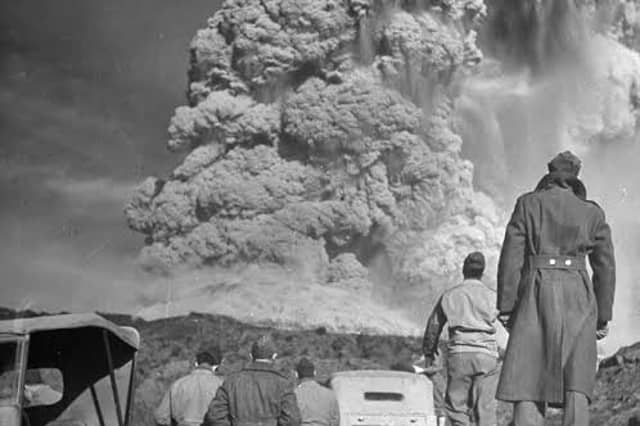

Mount Vesuvius added to the bombardment back in March 1944
IN March 1944, while Allied forces hammered away at the fortified Gustav Line, there was a show of force from Mother Nature that far outweighed any barrage that the 2/6 Battery could throw up.
Mount Vesuvius erupted violently for the first time in decades, and, although stationed 19 miles away at Castellammare, the battery was diverted to emergency civilian relief as lava flows threatened nearby villages.
Recalling the awe-inspiring, profoundly atypical situation, Tom remembered how ‘one village on the mountainside was overwhelmed by lava and troops with transport were standing by to evacuate everyone’.
The spectacle of the erupting volcano made for ‘a wonderful sight at night, the mountain generating its own electricity’.
“Around the crater the lightning was flashing in all directions. Pieces of stone, lava, etc. kept falling all around us. We had to wear our tin hats and greatcoats."
The more superstitious of the civilian population saw the eruption of the dormant volcano as a grim omen of things to come.
“The sun was completely blocked out for a week or more,” Sgt Moore wrote, “and day was turned into darkness.
“A big majority of the Italians thought the end of the world had come.”
Rome fell to the Allies on June 4th, 1944. The first Axis capital city to fall, it briefly captured the attention of headlines on the home fronts for all but one day before the Normandy landings began on June 6th.
The Italian front, so costly and hard-fought, thereafter became something of a strategic and logistical backwater as both sides rushed to reinforce their armies in France.
Bitter fighting in Italy continued through to the war’s end, but the theatre had become a sideshow. The final outcome of the war would be decided on the Eastern and Western fronts.
As for Sgt Moore and his comrades in 2/6 Battery, the end of the war came as abruptly as it began. Sent home on leave in September 1944, they were then redeployed for home defence - the Germans having begun a second blitz on British cities with their V1 and V2 rockets.
The formation was never again sent overseas, and Sgt Tom Moore was demobilised in November 1945. By that time, the Second World War had been over for three months.
One day whilst going through his father’s belongings, Tom Moore Jr found a letter of unknown origin written by an English WW2 veteran in the 1980s. In it, he speaks of the ‘men with a welcome as broad as their accents’ of the ‘Ninth Londonderry Regiment Ack Ack’- the umbrella formation to which 2/6 Battery belonged.
“Men from Ballymena, Coleraine, Larne, Portrush, Cookstown and Enniskillen, and men from across the border,” the letter states, “they were warm hearted…and they accepted us as colleagues without any questions.
“There were no Ulstermen, Englishmen, or Republicans, no Catholics, no Protestants and no Conformists, only a nameless unity of all of these.”
Preserved through his son’s care and diligence, Sgt Tom Moore's journal remains a testament to the local men who left Ballymena and towns just like it all over the country to serve in what was the largest conflict in human history.
Their courage was nothing short of heroic, but they were not born heroes. They were ordinary people thrust into extraordinary circumstances - and accounts like Sgt Moore’s are more important than ever, as the lessons of the past fade away in tandem with the dwindling generation who faced the abyss and learned them in the hope we wouldn’t have to do so ourselves.